
TL;DR
How to identify pure turmeric powder?
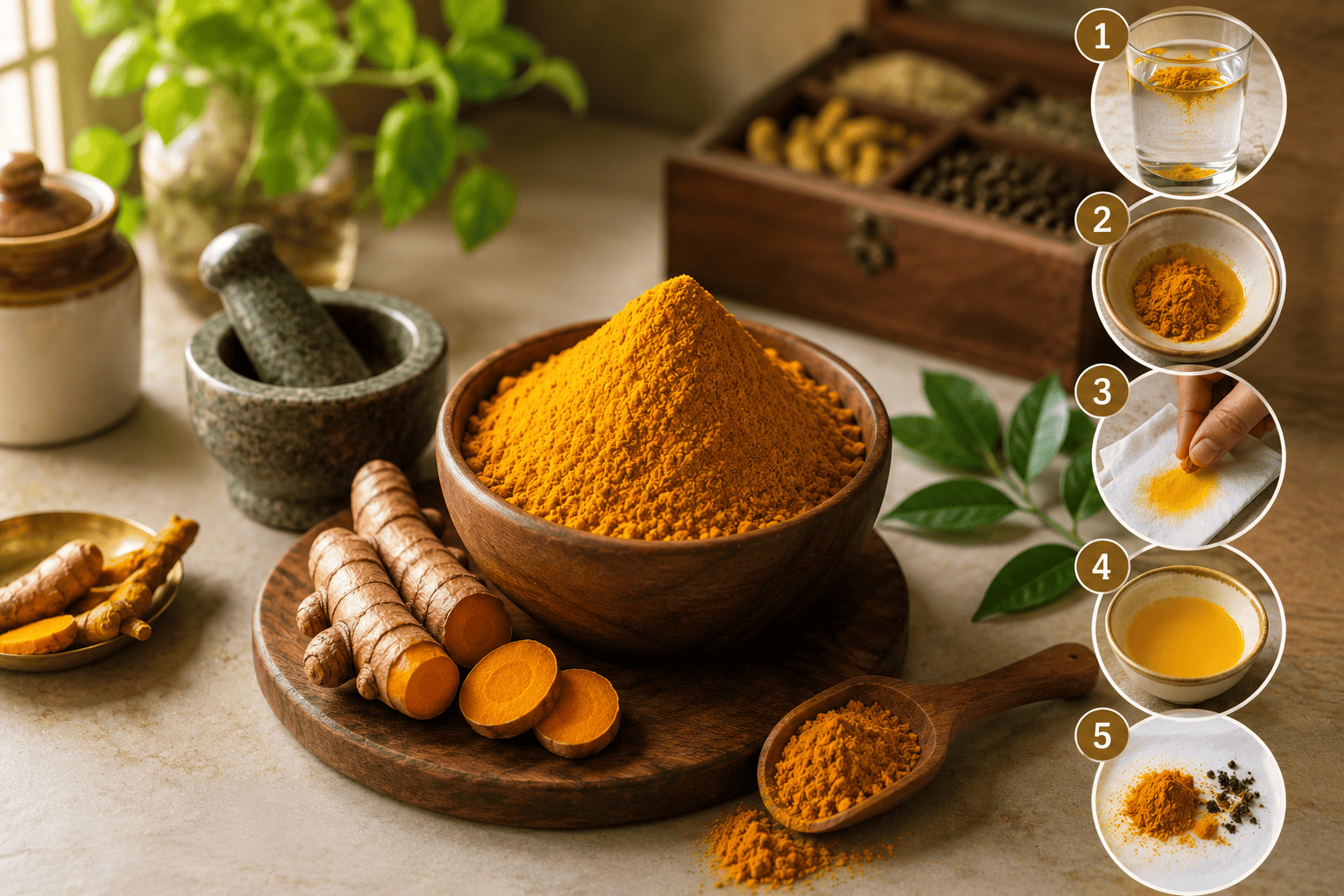
To immediately find out whether your spice is pure turmeric powder, do the following test – it's called the Water Settling Test:
Put a spoon of your spice into warm water without stirring.
Leave the mixture untouched for 20 minutes.
Conclusion: If it's pure turmeric powder, the spice should settle completely on the bottom and the water will be clear with light yellow color. In case of adulterated turmeric powder, the water will be either cloudy or will show dynamic streaks or an unnaturally bright yellow color in the solution.
The Golden Threat: How to Tell If Your Turmeric Is Real
Turmeric (Haldi) has earned a reputation around the world as an amazing natural medicine. From anti-inflammatory properties to metabolic processes, the advantages of this amazing spice have long been recognized. But as the demand grows around the world, this product has joined the list of the most commonly adulterated spices.
When you buy turmeric powder, you want a natural product that contains lots of curcumin – this is the main medicinal component of the spice. Sadly, this spice has become widely adulterated on the market. Spices sold in stores may contain not only harmful substances but also cheap fillers, such as chalk powder, starch, and sawdust. Also, in order to make the color more golden, unscrupulous sellers add highly toxic industrial dyes, such as Metanil yellow and Lead chromate. Eating such a substance not only negates all the benefits of your meal but can also be fatal for your body.
In this article, we will analyze how to identify pure turmeric powder and distinguish from its fakes.
The Dangers of Toxic Adulterants
Before getting to the testing procedures, it is important to know what could possibly be hiding inside that adulterated spice bottle. Adulteration may happen in two broad ways:
Whereas bulk fillers such as starch and chalk will reduce the effectiveness of the spice and cause digestive problems, chemical dyes carry serious threats. Metanil yellow is a chemical compound mainly used in the textile industry and research indicates that it poses serious neurological hazards as well as severe stomach irritation upon ingestion. On the other hand, lead chromate is even more toxic in that it acts as a potent neurotoxin leading to accumulation of heavy metals in the body.
Learning how to identify pure turmeric powder is not only necessary for quality but your family’s safety as well.
5 Easy Tests at Home to Check Turmeric Authenticity
It does not require sophisticated chemistry to detect these adulterants. You just need to conduct these five easy tests at home using simple materials.
1. Water Settlement Test (Most Suitable for Starch & Chalk)
Turmeric in its natural form is denser, hydrophobic in nature, and consists of particles which settle in predictable fashion after mixing them with liquids.
Procedure: Fill a glass with warm water. Sprinkle 1 teaspoon of turmeric on the water surface without stirring or shaking the glass. Wait for about 15-20 minutes.
Science: As natural turmeric is heavier and insoluble in water, the particles will gradually sink at the bottom of the glass. After settling, the water level on top will be completely clear, except for light yellow color.
Result:
Pure: The powder forms clearly at the bottom of the container, while the liquid above the powder is still transparent.
Adulterated: Any murky or milky appearance to the liquid means that your turmeric powder contains some other material such as starch, flour, or chalk. The presence of neon yellow colored clouds within the liquid indicates artificial dyes.
2. The Hydrochloric Acid/Lemon Juice Test (Ideal for Metanil Yellow)
Metanil yellow is an artificial azo dye that exhibits a vivid color change in strong acidic media. In scientific laboratories, the test uses concentrated hydrochloric acid; at home, however, one may reproduce the chemical reaction through the use of concentrated lemon juice or ordinary vinegar.
Procedure: Get a small container or bowl and place half a teaspoon of ground turmeric into it. Add some drops of water, thus creating a thick paste. Then, drop enough fresh lemon juice or white vinegar in small drops into the mixture and wait for 2-3 minutes.
Explanation: Metanil yellow functions as a classical pH indicator. When the environment becomes highly acidic, the molecules undergo a transformation resulting in an immediate color shift into dark red.
Result:
Pure: The turmeric paste should remain natural in color and remain either deep yellow or amber in color when subjected to the acid.
Adulterated: When the paste changes its color to a brighter shade of pink or magenta or red to crimson in color when the acid comes in contact with the powder, Metanil yellow is an indicator that the adulteration has taken place in the turmeric. In case the color remains pink after mixing with water, this indicates the presence of a large quantity of adulterants in the spice.
3. Palm Friction Texture Test (Chalk/Sawdust Indicator)
Turmeric powder made from pure spices possesses an oily texture because of the essential oils like tumerone and atlantone naturally found within the powder. The artificial turmeric has no such texture and feels rough to touch.
The Method: A tiny pinch of the turmeric powder should be rubbed between the palm using the opposite thumb.
The Reason: Heat produced as a result of the friction brings the oils naturally present inside the spices out.
Result:
Pure Turmeric: The powder will have a smooth, slightly warm, and slight oily texture. It will leave behind a deep saffron-yellow mark which is very stubborn and hard to blow away from the lines of your palms.
Adulterated Turmeric: The powder will appear dry, gritty, or powdery just like flour. After tilting your hand and blowing on it gently, a large amount of the powder will blow away, leaving just traces of the color.
4. Smell Test (Suitable for General Subsets)
Being odorless, mass-produced adulterants such as chalk, starch, and artificial coloring materials dilute the distinctive strong smell of turmeric roots.
Procedure: Take one tablespoon of turmeric powder and put it in an open container. Crush it slightly using the back of the spoon to release all volatile gases. Bring the container close to your nose and smell it.
Science: Turmeric has a blend of different volatile compounds responsible for its sharp, woody, and pungent smell mixed with ginger.
Result:
Pure Turmeric: One will easily detect the strong and earthy wood-like smell of the turmeric.
Adulterated Turmeric: In this case, there will hardly be any scent at all or else, the scent will be dull. If the turmeric smells like chalk, flour, or anything else rather than having an identifiable scent, then most probably it has been colored artificially. Also, it is worth noting that when the color of the turmeric looks exceptionally bright yet has no scent at all, it was artificially colored.
5. Fire Burning Test (Suitable For Wood Fillers And Paper Dust)
While pure turmeric will burn smoothly, mineral fillers and man-made fibers change the way the powder reacts to burning.
The Process: Pick up a small portion of turmeric powder using the metal spoon, then hold the powder near a source of flame such as a candle or a gas burner.
Scientific Explanation: Pure plant matter reacts differently when it comes into contact with high temperatures due to cellulose nature and lack of moisture-absorbents.
Result:
Pure: The powder will catch a clean singe or charcoal texture smoothly without producing heavy, acrid black smoke or explosive sparks.
Adulterated: If the powder crackles loudly, produces sudden bright sparks (a common indicator of mineral chalk or magnesium traces), or releases an offensive, chemical-heavy smell resembling burnt paper or plastic, it contains foreign materials.
Summary Matrix
Here is a summary of how to check turmeric purity:
Test Name | Target Contaminant | What Pure Looks Like | What Adulterated Looks Like |
Water Settling | Flours, Starches, Chalk Dust | Settles completely; water stays clear | Water turns cloudy, milky, or muddy |
Acid Interaction | Metanil Yellow Dye | Retains a stable yellow-amber tint | Turns a vivid pink or dark crimson |
Palm Friction | Chalk Powder, Coarse Sawdust | Smooth, oily; leaves a deep stain | Gritty, dry texture; easily blows away |
Aroma Evaluation | Diluted/Fake Product | Pungent, woody, earthy, and sharp | Flat, dull, odorless, or smells of raw flour |
Flame Reaction | Cellulose/Mineral Fillers | Burns cleanly, darkens evenly | Crackles, sparks, or smokes heavily |
Secure Your Wellness with Absolute Purity
Still confused about how to identify pure turmeric powder?
Well, when you use turmeric for its potent health properties, there should be zero compromise on its composition. Unfortunately, supermarket brands often rely on long, non-transparent supply chains where spices are subjected to high-heat mechanical milling—a process that strips away native essential oils-or blended with anti-caking agents to extend shelf life.
If you are looking for single-origin, untampered, and exceptionally vibrant botanicals, check out the options at Vanatva. Vanatva works directly with regional farmers to source clean, unadulterated, and nutrient-dense spices. By utilizing low-temperature processing and avoiding all chemical additives, fillers, or artificial colorants, they deliver pure turmeric powder that retains its natural curcuminoids and therapeutic compounds intact. Elevate your culinary wellness by sourcing your kitchen essentials directly from nature at www.vanatva.com.
FAQs
Q1: What is the simplest way to know whether my turmeric is pure?
A: The simplest way would be to use a water test. Add a teaspoon of turmeric to a cup of hot water without stirring it. Pure turmeric is quite heavy in weight and settles down without causing any cloudiness in the water. Impure turmeric has starches or chalk, which makes the water cloudy.
Q2: Why is the consumption of metanil yellow dye harmful to me?
A: Metanil yellow is a very strong chemical dye, used in industries. Its consumption is extremely hazardous for health. It irritates the stomach and affects the nervous system.
Q3: Why does turmeric cause a stubborn stain on the skin?
Ans: The pure form of turmeric has potent natural pigment along with its essential oil. The essential oil bonds with the minute grooves of your skin. Artificial yellow dye lacks essential oils in it, making it easy to wash out from the skin.
Q4: Is it possible to know that the turmeric is pure by the bright yellow color?
A: No, the color does not always indicate purity. Dishonest businessmen use artificial color to give a golden glow to low-grade turmeric. The best way to verify its purity is through its aromatic scent.