

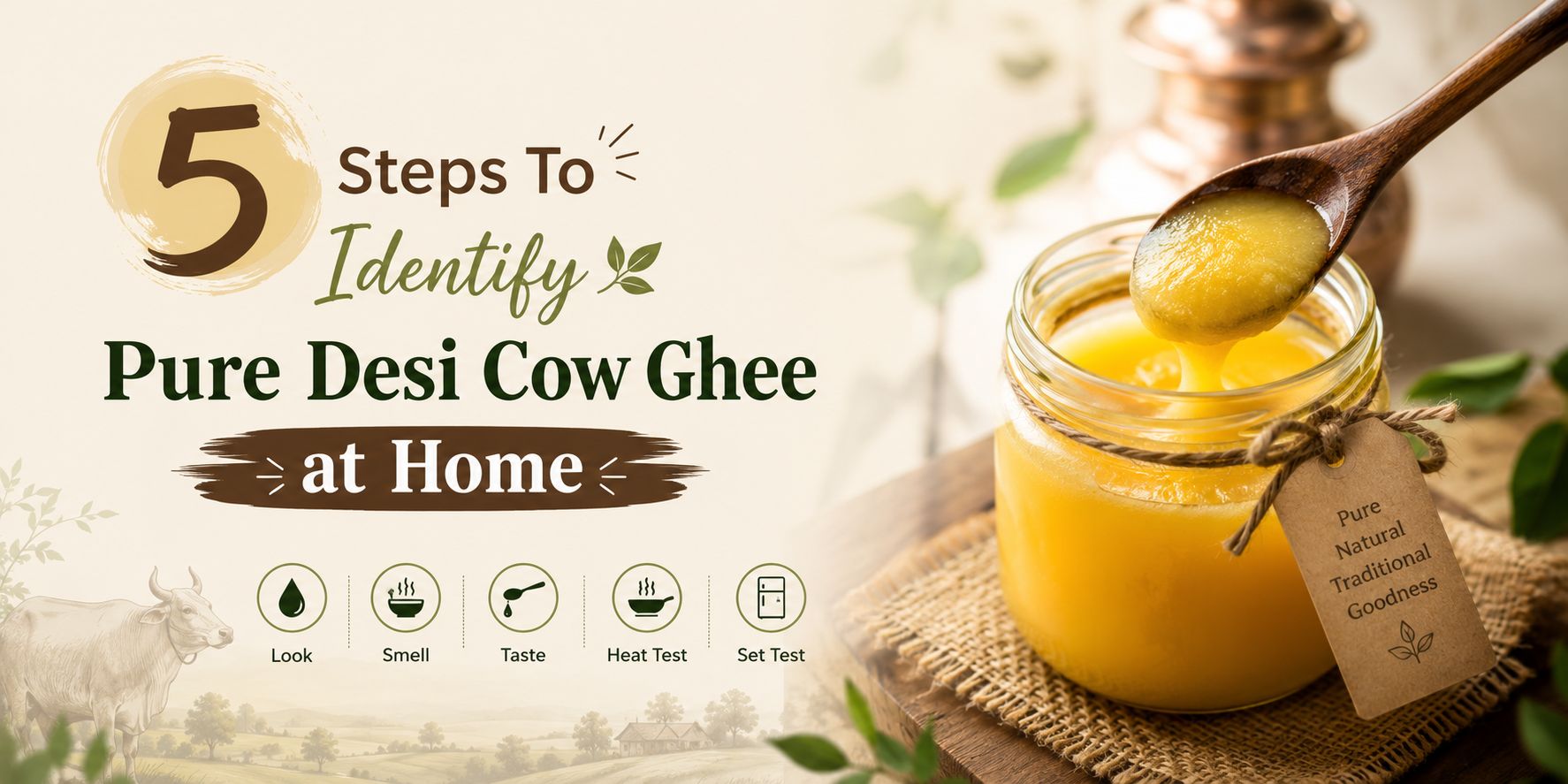
Just imagine having a jar of the delicious ghee open to get that amazing aroma of nostalgia, but getting nothing but a greasy one. Today, it seems next to impossible to find pure ghee. The grocery stores are filled with beautiful jars with all the promises of tradition in it, which are nothing but adulterated by some vegetable oil, starch or animal fat.
How can you ensure that the premium price you pay for it actually gives you health benefits and not any toxin?
There is no need for an advanced chemical lab to protect yourself from adulterated ghee. In fact, you can learn how to identify pure ghee right in your own kitchen using simple, scientifically backed methods. This guide explains how to detect the purity of ghee at home through easy, practical tests. Let's explore how to test the purity of desi ghee at home.
Why It Is Important To Have Ghee Purity
For centuries ghee has formed the basic ingredient of holistic well-being. Yet, its high demand in the market makes ghee vulnerable to adulteration. Unscrupulous producers tend to add some cheap additives to the pure ghee thus maximizing their gains. The most commonly used adulterants include:
Hydrogenated Vegetable Oils (Vanaspati). Although Vanaspati has a visual similarity to granulated ghee, it contains the trans-fats that adversely affect your heart functioning.
Starch and Mashed Potatoes. These additives help to create an illusion of heavy texture characteristic of traditional desi cow ghee.
Animal Effluents and Synthetic Fats. Such adulterants cause serious health threats immediately affecting digestion and other functions.
Genuine pure desi cow ghee is made from the milk fat of local cows using the traditional method of Bilona churning. From the chemical composition, it consists of the definite medium-chain fatty acids, such as butyric acid. They not only melt smoothly at body temperature but also accelerate your metabolism. Ingesting adulterated ghee, you deprive your body of useful vitamins (A, D, E, and K) and poison it with dangerous substances. That is why learning about ghee purity testing techniques is vital for your family's daily wellness.
Five Easy Ways to Spot Real Ghee Made from Desi Cows at Home
This is a list of five scientifically proven methods that show you how to check desi ghee purity at home and distinguish real ghee from fake variants.
1. The Heat and Melting Test
The melting point is one of the exact physical properties of pure cow milk fat. Pure cow ghee has a fairly low melting point ranging from 32∘C to 35∘C.
The Method: You need a clean stainless steel container or a ladle. Switch on the stove and set it to medium fire. Place one spoonful of the ghee in the ladle.
The Observation: Take note of how quickly the fat melts. The real desi cow ghee will melt immediately and turn into a deep brownish-golden shade.
The Red Flag: When the ghee takes time to melt, or turns yellow or white when it melts, it means that it is heavily adulterated. The reason for this behavior is that vegetable fats and oils have a much higher melting point than pure animal fats.
2. The Palm Melting Test
Warmth is produced within our body, and the average temperature of the human body is about 37∘C. Since the temperature of the human body is just above the natural melting point of pure dairy fat, your hand can be used for testing purpose.
Procedure: Take a small amount of ghee directly from the jar. Put it straight onto the back of your hand or workspace. Do not rub your hands; just place the ghee on your skin.
Observations: If the ghee is pure, then it will instantly react to the warmness of your skin. It will melt down and flow like water on your hand without rubbing.
Caution: The adulterated product will stay solid, viscous or waxy on your skin. If you need to rub it physically in order to melt it, or if it leaves plasticity on your skin after melting, then it is adulterated with hydrogenated oil or paraffin wax.
3. Iodine and Starch Test
There are many dishonest producers who use mashed potatoes, sweet potatoes or cornstarch in their product. Such ingredients increase the bulkiness of the product and provide graininess artificially. It is very easy to detect this trick using simple chemistry reaction with iodine.
The Procedure: First of all, we should melt one tablespoon of the product in a small glass or translucent bowl. Next, some drops of the regular, store-bought liquid iodine solution should be poured into the melted fat and stirred with a spoon.
What You Should See: In case the sample is pure, the iodine solution will just keep its own reddish-brown color. The golden color of the ghee will not be changed.
The Sign of Contamination: In case there is any blue, purple or violet color produced, there must be starch in the sample. Iodine chemically interacts with starch molecules forming a dark blue complex. When the solution turns blue, throw away the jar right now.
4. Double Boiler Solubility Test
Various fats react to very low temperatures in various ways. Through the use of gradual cooling, it is possible to be able to identify the presence of a number of oils in your container.
Procedure: Collect some ghee and put it into a glass jar. Gradually heat the jar with the help of a double boiler until the oil becomes completely clear. Then, take that glass jar and keep it in your refrigerator. Let it remain there undisturbed for one whole hour.
What to Look Out for: When fully cooled, real ghee will solidify and form a completely uniform golden color mass. From the top right down to the bottom of the glass, it will appear to be exactly the same.
Warning Signal: The appearance of distinct layers in the glass means that the sample is not genuine. There will be a solid mass of material in the bottom part while an additional runny layer of oil will be above it. This separation occurs because different vegetable oils freeze differently compared to milk fat.
5. Hydrochloric Acid and Sugar Test
It is a very famous chemical test for the detection of presence of sesame oil or cheap vegetable fat which is often added in batches of ghee to increase their amount.
The Procedure: One table spoon of melted ghee is added in a test tube or glass bottle. One pinch of pure white sugar is added in the tube. Now, add 5 ml of concentrated hydrochloric acid (HCL). The container should be sealed and shaken for about half minute. Then allow the mixture to stand still for five minutes.
The Observation: The acid layer in the lower portion will remain clear or light white in case of pure ghee.
Warning Sign: If the layer of acid becomes pink, crimson or red colored, it means that the sample of ghee has trans-fat or compound oils.
Comparison Table: Pure Ghee vs. Adulterated Ghee
If you're wondering how to check ghee purity, the quick reference table below highlights the key differences between genuine and fake ghee.
Evaluation Metric | Pure Desi Cow Ghee | Adulterated Ghee |
Melting Speed on Heat | Instantaneous (within seconds). | Slow, sluggish, and requires high heat. |
Color Upon Melting | Dark golden-brown color. | Pale yellow, translucent, or cloudy white. |
Reaction to Palm Warmth | Melts purely from natural skin temperature. | Stays semi-solid, waxy, or clumps together. |
Iodine Solution Test | Stays clear; retains the brown iodine hue. | Turns a distinct dark blue or purple color. |
Cooling Structure | Solidifies into a single, uniform layer. | Separates into multiple greasy layers. |
Natural Room Aroma | Rich, earthy, sweet, and distinctly nutty. | Synthetic, faint, chemical-like, or odorless. |
The Sensory Guide: See, Scent, and Feel
Although chemical analysis will provide you with conclusive results, there are some methods that will help you learn to identify pure ghee using your senses.
The Look
Pure ghee has a natural golden-yellow hue. The yellow color is due to beta-carotene, which occurs naturally in grass-fed cows’ milk. Pure ghee, when kept at room temperature (20∘C to 25∘C), will be naturally layered in tiny bead-like particles. Should your ghee be perfectly smooth, glossy, or sheet-like as commercial shortening, it was heavily processed industrially.
Scent of the Product
Genuine ghee has a unique scent. The scent permeates the entire space once a spoonful of ghee is heated in the pan. Fake products have a weak, greasy or staled cooking oil smell. Some unscrupulous producers add artificial butter flavors. However, when such scented ghee is heated up in a pan, the scent disappears leaving behind greasy smell.
The Texture Feel Test
Apply a small amount of ghee in-between your index finger and thumb. Genuine ghee will be very light, smooth, and readily absorbed by the skin. If it has an oily feel that is sticky, too thick, and is not easily washable with just plain water, it must have some mixture of vegetable oils in it.
Unleash Unadulterated Authenticity with Vanatva
There is no need for trial-and-error in discovering authentic wellness products. If you seek peace of mind from the uncertainties involved in experimenting in your kitchen and want assured authenticity, try out the range available with Vanatva. Made with utmost reverence for the conventional ways, Vanatva provides truly authentic products that respect your health and culture. Their products are made hygienically, ensuring that they deliver the true aroma and richness to your family. Check out their authentic range now with Vanatva.