

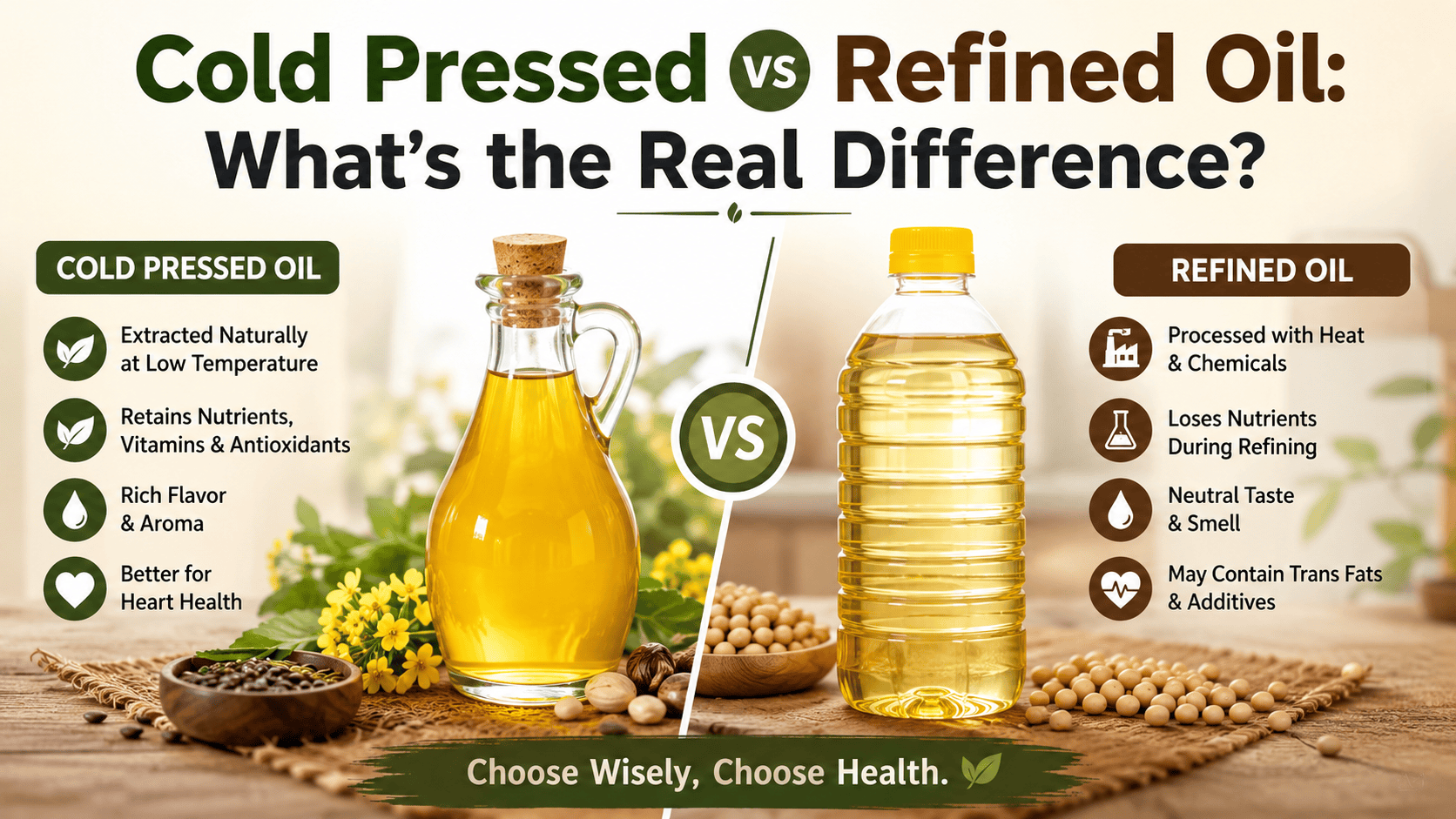
Go ahead and take a peek into any contemporary kitchen, and you'll find a bottle of cooking oil next to the stove. This clear fluid is an important ingredient in every meal that we cook in the kitchen, whether it is a quick stir-fry or a slow-cooked curry. But then walk down the aisles of your local supermarket and try to pick one out from among all the varieties of oils there are. The sleek-looking bottles of "ultra-refined", "double-filtered" or "healthy and light" oils sit beside bottles of "100% cold pressed" and "traditional" oils made out of rustic glass.
While most of us usually pick out the most attractive looking one or the cheapest one without much thought. Have you ever wondered what process takes place before the oil gets inside your cooking pan? Is there some negative impact to our health in the form of that odorless, colorless fluid in your kitchen cupboard?
The question of whether cold pressed or refined oils are better is no longer a short-lived fad in the realm of wellness. In fact, it is a clear-cut issue of opting for one of two ways of oil production: chemical industrial treatment versus nutrient conservation. This guide aims to reveal what lies behind those processes in detail to provide a comprehensive comparison of the two.
What Is Refined Oil? The Industrial Process Revealed
In order to understand what makes refined oil the most common type of cooking oil in stores, it is important to know the process by which it is obtained. The main features of the product include large-scale production, long shelf life, and absolute uniformity. As for raw materials, they often include cheap oil seeds or residual products that require further processing to extract fat:
The process includes extreme heat, pressure, and several chemicals:
Solvent Extraction: Crushed oilseeds are dissolved into a solvent such as hexane, which is a product obtained during processing of crude oil. Hexane dissolves almost all of the oil present within the seeds in order to give maximum volume yield to the processor.
Degumming: Crude oil is treated with water or acids that are used for food products such as phosphoric acid in order to separate natural gums, phospholipids and resin-like compounds.
Neutralization: Free fatty acids that lead to rancidity of the oil are extracted from it using an alkali such as sodium hydroxide. This process generates a by-product known as soap stock.
Bleaching: Bleaching earths or activated carbon are added to the oil in order to remove natural pigments and colors from the oil. This process gives oil its pale color.
Deodorization: In this process the oil is heated to very high temperatures between 220°C and 260°C in a vacuum. Steam is used in order to remove all of the natural odors and flavors of the oil.
Although all of these multiple chemical processes make the oil stable with a high smoke point and a long shelf life, it deprives oil of its natural qualities and benefits.
What is Cold Pressed Oil? The Traditional Approach
The process of extracting cold pressed oil, also known as Kachi Ghani or wood pressed oil, involves using age-old methods of physical extraction. Instead of using heat and chemicals for extraction, this process utilizes physical means to extract oil from seeds/nuts.
For example, in the case of cold pressing set-up like the wooden ghani or a stainless-steel screw press, the oilseeds are ground at very slow speed and rotations:
Low Heat Generation: The friction caused by the machine is controlled so that the heat generated remains below 45∘C to 50∘C during the process.
No Chemicals: No chemicals such as solvents, acids, and bleaching agents are added at any stage of the process.
Simple Filtering: The oil, once pressed, is stored in holding tanks where it is left to separate naturally and filtered through simple cloth/paper filters for the removal of solid residue.
Due to lack of heat and chemical usage in cold pressing, the oil thus extracted contains the full range of flavors, earthy aroma, golden color, and vitamins/antioxidants.
Key Differences: Cold Pressed vs Refined Oil
Understanding the structural difference between cold pressed and refined oil these two oil types makes it easier to evaluate their place in your daily diet. Here is a clear breakdown:
Parameter | Cold Pressed Oil | Refined Oil |
Extraction Method | Mechanical crushing at low temperatures (<50∘C). | Chemical solvent extraction using hexane and extreme heat (>220∘C). |
Chemical Additives | Completely free from solvents, alkalis, and bleaches. | Treated with hexane, caustic soda, bleaching earth, and synthetic preservatives. |
Nutritional Profile | Rich in natural vitamins (A, E, K), antioxidants, and essential fatty acids. | Heavily degraded; essential vitamins and natural compounds are stripped away. |
Aroma and Flavor | Retains the natural, rich, and distinctive aroma of the parent seed. | Completely odorless and neutral in flavor. |
Visual Appearance | Deep, natural color (golden, deep amber, or greenish-yellow) with natural clarity. | Pale, crystal-clear, and bleached yellow. |
Trans-Fat Content | Zero synthetic trans-fats; natural molecular structure remains intact. | May contain small amounts of trans-fats formed during high-heat deodorization. |
Shelf Life | Shorter shelf life (typically 6 to 12 months) due to the absence of synthetic preservatives. | Long shelf life (up to 24 months) engineered through heavy processing. |
Advantages of Cold Pressed Oil over Refined Oil
When considering the nutritional value of cooking oils, it becomes obvious that cold pressed oils have certain functional benefits over refined oils. The main benefits of cold pressed oil include the following:
1. Preservation of Key Nutrients and Antioxidants
The biggest benefit of using cold pressed oil is related to preservation of its complete nutritional content. High temperatures kill delicate active components. Being processed under cold conditions, all valuable nutrients remain in their integrity:
Vitamin E (tocopherols): A powerful antioxidant which provides protection from free radicals and promotes cell regeneration.
Phytosterols: Active plant components which hinder cholesterol absorption in the digestive system.
Polyphenols: Compounds which help in reducing inflammation in the organism.
Refining process involving high temperature (>200∘C) and acids causes up to 80–90% loss of natural antioxidants.
2. Free from Chemical Solvents and Residues
In the refining stage, the seeds will be cleansed using chemicals such as hexane. While these solvents are evaporated during the refining process, residues may remain in the oil. Moreover, the application of caustic soda and bleaching earth on the oil will cause a change in the natural condition of the oil. Buying cold pressed oil ensures you will not consume any chemical solvent, residues, or artificial preservative in your foods.
3. Protection against Trans Fatty Acids
Trans fatty acids are one of the biggest concerns about the ultra-refining of oil. In the deodorization of the liquid oil, the repeated exposure of the oil at the temperature of more than 200∘C causes a change in structure of unsaturated fatty acids into the trans-fatty acids. Trans-fatty acid increases LDL (low-density lipoprotein or bad cholesterol) while reducing HDL (high-density lipoprotein or good cholesterol). Cold pressed extraction works at much lower temperature.
4. True Flavor and Reduced Usage
Since cold press oils have the true flavor of the actual seeds that they are extracted from, whether they are sesame seeds, mustard seeds, groundnut seeds, or coconut seeds, they really add flavor to your dishes. As the flavoring factor of the oil is so good, there is less need for oil in your food as compared to refined oils which do not provide any flavor.
Health Benefits of Cold Press Oils in Detail
Using cold press oils in your day-to-day life gives you numerous health benefits. Let's explore the benefits of cold pressed oil over refined oil and discover why cold press oils are considered a healthier option.
Properties for Heart Protection
Cold pressed oils have a very healthy ratio of Monounsaturated Fatty Acids (MUFA) and Polyunsaturated Fatty Acids (PUFA). The good fats provided by cold pressed oils contribute to healthy arteries, decrease inflammation in the body, and maintain healthy blood pressure levels.
Enhanced Digestive System Functioning
Unlike other oils that may be heavy and leave a greasy residue in the mouth, cold pressed oils are easily recognized and assimilated by the human body. Substances such as lecithin help maintain proper functioning of the liver and ensure that dietary fats are properly digested.
Optimized Nutrient Absorption
Some important vitamins are fat-soluble vitamins. In simple terms, your body will not be able to absorb these vitamins without the aid of healthy fats in your diet. The fatty acid chains present in unadulterated cold pressed oils ensure that your body absorbs all the nutrients from the vegetables and grains in your diet.
Cooking and Smoking Point Issues
The biggest issue most people have with the use of cold pressed oils is their usability in various forms of cooking. Knowing about smoke points, that is, the point at which the oil stops glowing and starts smoking is crucial for every cook.
Cold Pressed Oil Cooking Tips:
Don’t Heat Unrefined Oils Too Much: Although cold pressed mustard and groundnut oils are very good at tolerating high temperatures when cooking, it’s better to use oils such as extra virgin olive oil or cold pressed flaxseed oil for light sautéing and drizzling only.
Always Pre-Heat Your Pans: To avoid overheating and burning your oil, always pre-heat your pans before adding cold pressed oil to your dishes.
Right Storage Conditions: Store your cold pressed oils in the kitchen cabinet, in the shade and not under any direct exposure to light and heat. Cold pressed oils lack artificial preservatives, which means that they are susceptible to heat and light-induced oxidation.
Environment and Economy Issues
Making a choice between cold pressed and refined oil has much more to do with environmental sustainability and agricultural economy:
Industrial Setup vs. Conventional Craftsmanship
Oil refining needs a very large industrial setup along with huge consumption of electricity to produce steam and also uses considerable amounts of water for degumming and neutralization processes. The byproducts of the chemicals used—such as bleaching earth and soap stock—are needed to be disposed of carefully in order to prevent any environmental damage. On the other hand, cold press method involves energy-free and chemical-free mechanical processing. The remaining solid cake of seed material left after cold press process is entirely natural and acts as cattle fodder due to its high nitrogen content.
Benefitting the Local Farmers
Cold pressed oils are usually linked to agricultural setups that are local and decentralized in nature. Pressing units (ghanis) buy seeds from local farmers.
Go for Pure and Genuine for Your Family
One of the easiest things that you can do for ensuring that you have clean eating every day is switching from the highly processed refined oils to traditionally cold pressed ones. Using oils extracted via mechanical pressure means getting rid of synthetic chemicals and having natural vitamins, antioxidants, and true flavor back in your kitchen.
Choosing kitchen essentials, it is very important to focus on those brands that are keeping alive the age old tradition of preparing their products. Experience the genuine and unaltered range of cold pressed oils and natural food products at Vanatva. Produced in a way to retain all of its natural goodness, Vanatva takes the pure nutrition right from nature’s lap to your kitchen table.